What you should never paste into ChatGPT, Claude or Gemini
In short
- Keys, passwords and other people's personal data do not belong in a chat, even with training switched off.
- Paste the shape of the data, not the data: placeholders give the same answer.
- Run a thirty second check before you press Enter.
In this guide
AI chats feel private. You type into a box, an answer comes back, nothing seems to leave the room. In practice the text you paste is sent to a company's servers, kept for some time, sometimes read by people during abuse reviews, and in consumer products it can be used to train future models unless you switch that off. None of that is a reason to stop using these tools. It is a reason to be deliberate about what goes in.
The short list
- Credentials and keys. Passwords, API keys, access tokens, session cookies, private keys, connection strings. A key that has been pasted anywhere should be treated as exposed and rotated.
- Other people's personal data. Names tied to situations, email addresses, phone numbers, home addresses, dates of birth, national ID numbers such as the Dutch BSN. You can share your own data if you choose to; sharing someone else's is a different matter under privacy law.
- Payment details. Card numbers, IBANs, bank statements. Even a partial statement reveals who pays whom and how much.
- Health, legal and HR material. Medical notes, case files, performance reviews, anything about a dispute. These are the categories regulators care about most.
- Unreleased business information. Pricing, roadmaps, customer lists, contract terms, source code with secrets or proprietary logic. Your employer's confidentiality rules apply to AI tools just as they apply to email.
- Logs and config dumps you have not read. A stack trace rarely looks sensitive, but the lines around it often contain tokens, hostnames, user emails and internal URLs. See how to share logs safely.
"But I turned off training"
Good, do that. Most consumer AI products let you opt out of model training, and business plans usually exclude training by default. It helps, and it is not the whole story:
- Opting out does not delete what was already sent. Retention periods of around 30 days for abuse monitoring are common, sometimes longer when a legal hold applies.
- Automated and human abuse reviews can still see the content.
- The provider can be breached, subpoenaed or simply make a mistake. In 2023 a bug briefly showed some ChatGPT users the titles of other users' conversations.
- Your employer or client may forbid it regardless of the provider's settings.
Settings reduce risk. They do not turn a third party's server into your own computer.
The better habit: paste the shape, not the data
Almost every useful question works just as well with placeholders. The model does not need the real email address to fix your regular expression, draft a reply or explain an error. It needs to know that an email address is there and which one is which.
Before:  "Hi Sarah, your order 48213 shipped to Keizersgracht 12, Amsterdam. Questions? Call +31 6 1234 5678."
After:   "Hi [NAME_1], your order [ORDER_1] shipped to [ADDRESS_1]. Questions? Call [PHONE_1]."
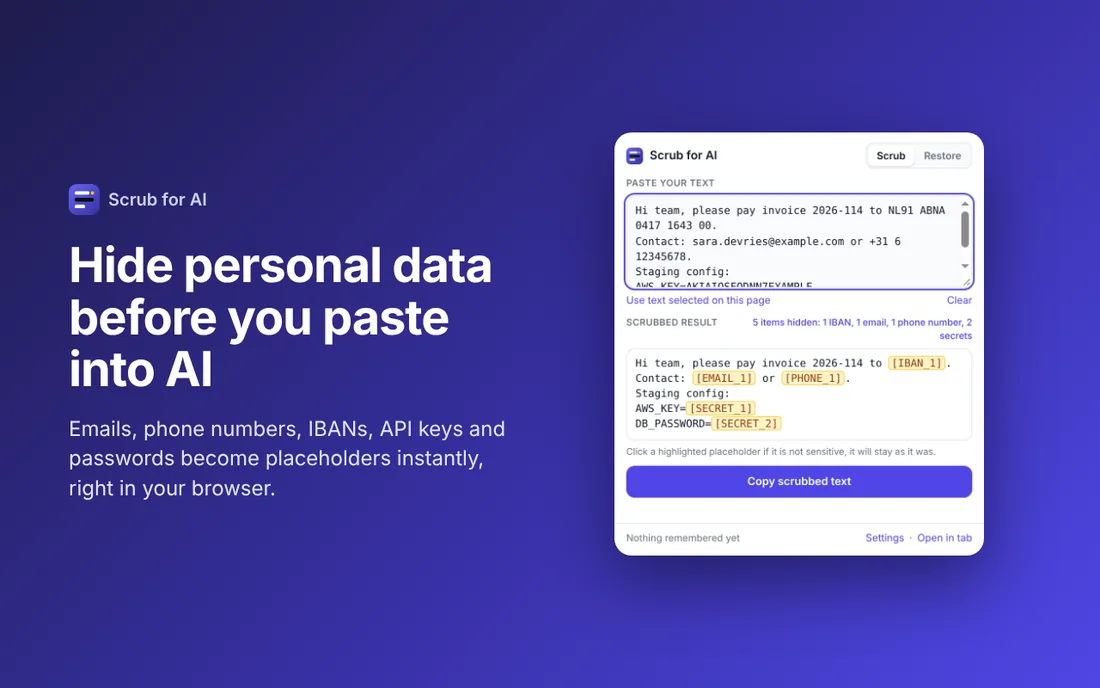
The answer comes back with the same placeholders, and you put the real values back on your own machine. Nothing sensitive ever left it. This is called pseudonymisation, and it is exactly what privacy regulators recommend as a first line of defence. We wrote a longer piece on why the placeholder method works so well.
A thirty second check before you press Enter
- Would I be comfortable if this text appeared in a data breach with my name on it?
- Does it contain anything about another person that they did not agree to share?
- Is there a token, key or password anywhere in it, including inside URLs and headers?
- Does the model actually need the real values to help me?
If the answer to the last question is no, which it almost always is, replace the values first. Doing that by hand gets old fast, which is why we built a tool for it.
Scrub before you paste
Scrub for AI replaces emails, phone numbers, IBANs, API keys and passwords with placeholders in one click, and puts them back when the answer returns. Free, runs offline, no account.
More: all guides · Scrub for AI · Copy for AI · Tables for AI